The method — Key to Eden ICLS
ICLS: Integrated Crop Livestock System — a livestock-driven cultivation method
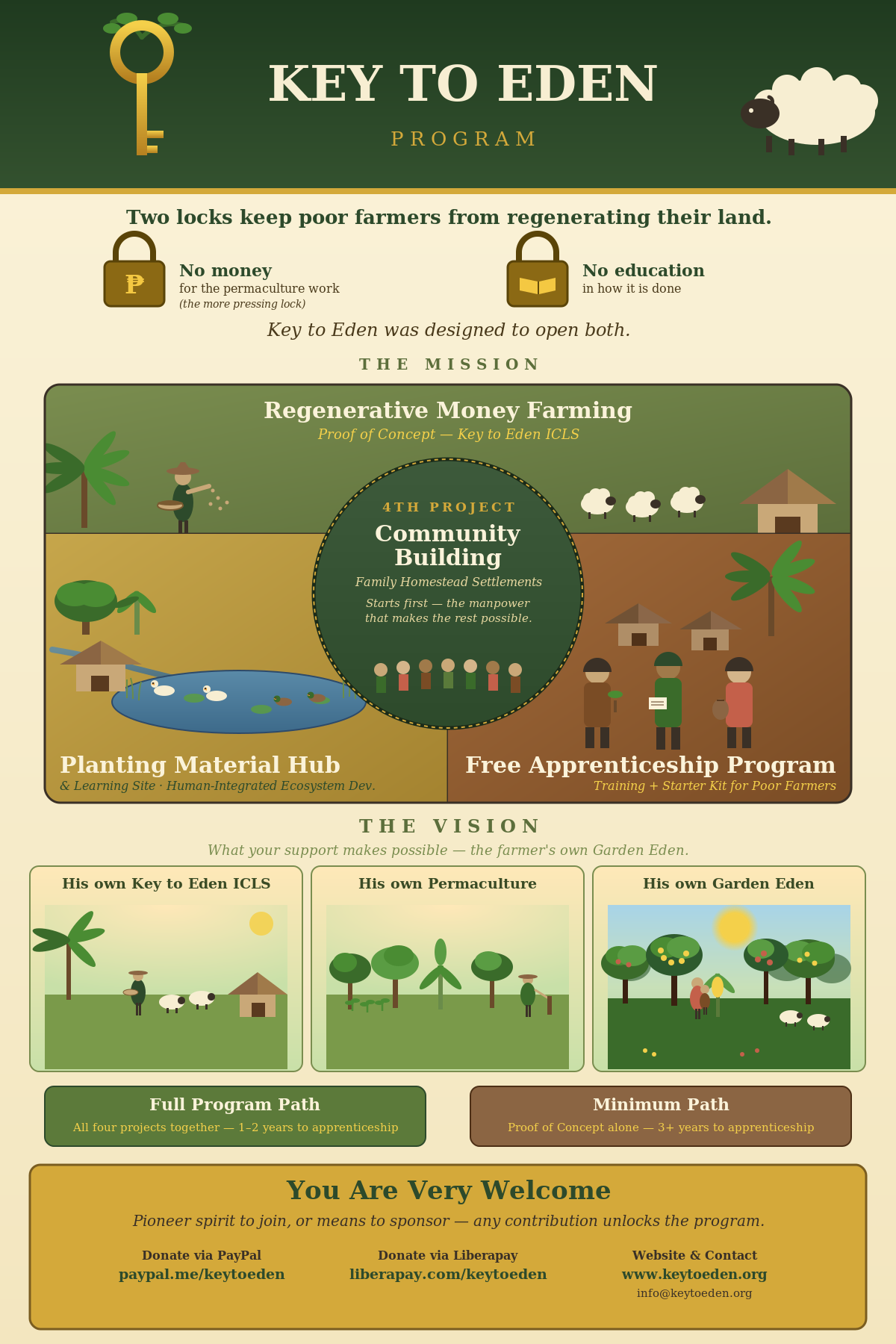
Each working unit is a 100 m² paddock (5 m × 20 m), enclosed in electrified sheep netting. A seed mix — Sunn Hemp, Alyce Clover, Daikon Radish, Pearl Millet, Japanese or Browntop Millet, Red Ripper Cowpea, Sunflower, Brown Mustard, Sesame and others — is broadcast over the paddock. Sheep graze the paddock for one day. Their hooves trample the seed into firm soil contact, and their dung fertilizes the ground. The flock moves daily into the next freshly sown paddock, alternating between two netting systems.
First harvests start after one to two months; longer-cycle crops complete the main cycle of four to five months. Soil improves with every cycle. The farmer is left with steadily improving soil, replicable seed stock, and cash income to finance the earthworks and perennials of a Permaculture Installation.
Around 2 hectares is the practical anchor for a full pilot. Smaller farms remain workable with a reduced rotation or smaller paddocks.
Key to Eden integrates several already-proven methods — Masanobu Fukuoka's Natural Farming, Prescribed Grazing, Pasture Cropping, Barahnaja Simultaneous Multi-Cropping. What the Proof of Concept concretely tests: sowing ratios and species proportions, livestock density, how many days without rain the seed still germinates, and how many days after sowing grazing is best introduced. Grazing strengthens root systems and increases the number of grain-bearing tillers in millets. Brassicas and cowpeas are likewise sown into grazed paddocks. Studies show that within two weeks of grazing, millet height is indistinguishable from ungrazed controls.